On the Run

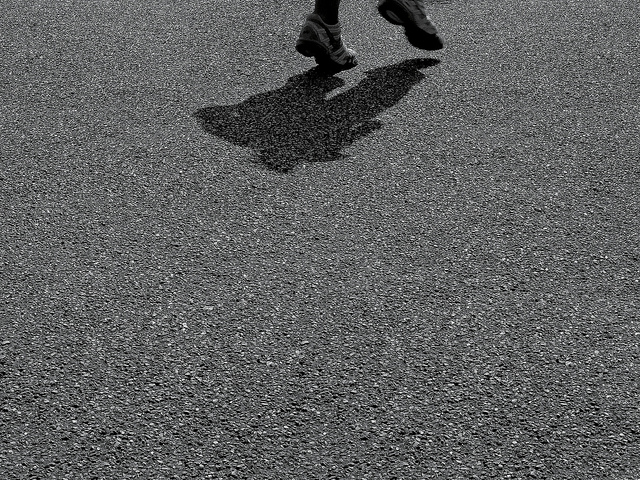
This photo shows sneakers during a run

“We train to race, we don’t train to train!”

Coach Sundberg‘s mantra would be oft-repeated in the three years I ran cross-country, spurred by team-wide resistance to a speed- or hill drill, sluggishness on a long run, or some who-needs-a-reason teenage rebellion during practice.

The first time I heard it, I may have laughed. I was never much of a racer, typically finishing in the middle of the LHS women’s team. I knew I wouldn’t be getting any scholarships for my athletic prowess, so my attitude was always one of showing up, doing my best, but also downplaying competition. And to his credit, Sunny (as he was always called) never pushed too hard – never enough to diminish the love of the sport, create animosity or bad blood among his runners, or cause anxiety beyond the natural pre-race jitters. I can’t remember him once losing his temper, using negative reinforcement, or ever belittling his team.

In fact, it was the opposite: Sunny’s zen-like attitude to “drink the dew” off blades of grass, break up wispy cirrus clouds with one’s mind during in-the-field stretches (“Look what you’re doing!”), or calling out gorgeous scenery during a long training run was a welcome antidote to the hyper-competitive ambitions of pre-college years. If I had a difficult exam, an argument with my parents or friends, or was stressing about some other teenage drama, I knew I could work it out—literally—through a good run, stretch, and lift with my cross-country coach and buddies.

It’s because of Sunny that I still love to go on a run, 20+ years later. Nowadays, I unabashedly train to train, and it’s downright joyful. It’s time for me to clear my head, to meditate, to work out something that’s been puzzling me. Sometimes, a good run is the only way for me to manage stress, anger, or anxiety: The rhythmic breathing, the repetition of each footfall faithfully following the next, the sated exhaustion at completing a route, all work together to quiet my frazzled mind. By the time I’m done, what seemed so stressful has diminished, what I couldn’t tackle before now seems manageable.

And so training to train has become something of a personal motto. Think about it: Most days, we’re not asked to race. We’re asked to put one foot in front of the other, to be steady, reliable, level-headed, on course, yet open to detours—all qualities of a great long-distance run. Marriage, parenting, a full-time job—these are all training exercises of the longest (and highest) order. Approaching each with dedication, a sense of calm, and appreciation make the preparation indistinguishable from the actual journey: An otherwise-nondescript Tuesday evening run has the possibility of a personal best time; a 5K Fun Run with a local running club is an opportunity to connect with colleagues and friends (or make new connections). A solo run on a gorgeous fall day triggers a memory of cross-country practice and reminds one to reach out to old friends on Facebook; a friendly wave from a stranger running by gives a boost of energy, and reinforces the shared experiences of runners, wherever one may be.

I hear through the grapevine that he’s retiring this year, and deservedly so. Thanks to him, even though no race awaits me, I know because of Sunny that the run will still be worthwhile, and worth doing. His legacy, for me, has been as enduring as endurance itself.

Photo courtesy Nick Page via Flickr

Decline

“Would you be interested in taking your grandmother’s dining room table?” my father asks.

I pause, and switch the phone to my other ear. Many others must have already declined, as I am by no means the first in line for an acquisition such as this, and I quickly count at least six older relatives who could have claimed it before me. I realize, mid-count, that my father is still talking.

“It wouldn’t be just the table; it also comes with a lovely hutch. I think whoever takes it will have to take the both of them, as a set.”

I try to picture the table. It is rectangular, I can recall that much. Long—dominating my grandmother’s (admittedly small) dining room. Most likely designed to seat six to eight comfortably, although when we were there it often had ten to twelve people crammed elbow to elbow around its perimeter. So many side to side that if your seat was against the wall, opposite the door, you knew you were in for the night. My sisters and I, at younger ages, would take bathroom breaks or steal time outside by escaping under the table, crawling below, past denim and sneakers, pantyhose and heels, to make a run for it.

The visuals fail me. Instead, the sounds at the table come forward, large and loud. Not to verify a stereotype, but with ten-plus Irish-Italian New Yorkers and Jersey residents packed in a small space, the conversation quickly went up in volume, and down in decorum. One year, after my aunt recalled a childhood story that depicted Nana in a less-than-flattering light, Nana called her an asshole in front of the crowd – all in good fun, of course. Insulting (and politically incorrect) nicknames from my father’s childhood inevitably would be used (often as a term of endearment) before the meal was through. And during the multiple simultaneous conversations, there was always the additional cacophony of silverware clinking on plates, new dishes to pass—family style—from the kitchen, more drinks to pour.

Memories of sound give way to recollections of taste. What stands out about Nana’s table, despite the years, was what was always served on it. There were rules to the menu at Nana’s, unchanging, regardless when we visited. Whether we made the trek to suburban New Jersey from Pennsylvania on the day after Christmas, or a random July afternoon during our summer vacation, we knew there would be some variation of the standards:

Roast pork with sauerkraut and “new” white potatoes (extra salty from a can), coated with so many drippings from the meat that their undersides turned dark.

Spaghetti with meat sauce—the meatballs and sausage variety, not the ground beef/Bolognese style. Green salad was served after the main course, as a palate cleanser, and always with crusty Italian bread to dip.

A side dish of pickled beets with pickled onions – regardless of entrée. For many years, I would try to get to the dish before my sisters, so I could devour all of the beets myself, only realizing in my later childhood years that Nana and I were the only ones who would partake.

Red jello, strawberry or cherry, served in parfait cups or with individual servings scooped out of a casserole dish.

Chocolate sheet cake with white icing. Each square slice was then to be cut in half and inverted so the icing would be on the inside, like a filling. This would then be eaten with one’s hands.

And, for most of my childhood, a thick fog of cigarette smoke hung over the table, curlicueing up from several ashtrays placed strategically around the spread, seeping into our clothes and hair, so that our pillow cases, the morning after our visit, would smell of smoke. Gradually, over the years, the number of smokers dwindled, until my step-grandfather was the only one – and even then, he would often go outside to light up.

It had been years, though, since I last had a meal at my grandmother’s house. In fact, the final time I had sat at the table, there hadn’t been anything from the standard menu at all.

It had been about a decade ago, on a trip to New Jersey with Andy, my then-boyfriend, now husband, for the sole purpose of introducing him to my paternal side of the family. It was a rare visit without my parents or my sisters. And I had called my nana a few weeks in advance, told her we would be in the area, and asked if we could have a meal with her.

“No,” was the unexpected answer. “I’m just not up for it.”

We hadn’t known it at the time, but the initial signs of Alzheimer’s were starting to show. She knew it. Her husband knew it. But she didn’t want us to know it. And if she were expected to cook a big meal, everyone else would discover what was, at that time, her own private realization.

So instead we went to her home for a low-key visit, buffered by my cousin and his wife, presenting a dozen doughnuts and a carafe of coffee we picked up on the way over. The six of us sat at the dining room table. It seemed excessively roomy, with plenty of elbow room and more than enough space to stretch out. No one smoked. The room I associated with noise and crowding was oddly quiet and spacious, and I found this otherwise-normal setting bewildering.

Or, truthfully, perhaps I worried because of her initial rejection, wondering whether I had offended her and her husband, if somehow, by coming with a partner and not my parents, if I had upset the natural order of things.

We snacked off paper plates, no silverware needed. Bob, Nana’s husband, showed Andy his latest woodworking creations, several of which were displayed on the neighboring hutch. Nana told Andy a few stories about me as a toddler – stories I had never heard before. And after about an hour, we left.

The phone line is quiet as my father waits for my response.

“I don’t know,” I say. “Let me think about it.”

Read the full essay at The Grief Diaries.

Connection or Reflection?

Nearly 50 years ago, Simon and Garfunkel sang about isolation: the loneliness of feeling like a solo island in I Am a Rock. One wonders what the duo might think of Apple’s iPhone ad campaigns, where an underlying message of isolation seems to be up for sale.

The campaign’s two ads, Rock God and Road Trip, depict Siri, the iPhone feature that (in theory) responds intelligently to voice commands. This is an incredible feature, and one Apple could have showcased brilliantly through simple examples of universal needs or experiences, expressed through common or emergency requests to Siri, followed by Siri’s accurate replies. (“Siri, I need to find a plumber immediately!”/”Ok, dialing the nearest 24-hour plumber right now!” “Siri, my daughter is choking, how do I do the Heimlich Maneuver?”/”Here’s a YouTube video that shows you how to do the Heimlich.”)

Instead, the new ads send an unintentional message of self-absorption and isolation. As depicted, Siri acts as an echo chamber, a one-way communication tool, where the phone reflects only the self back to its user. I suppose this should not be a total surprise from a company that blatantly tacks an “i” onto its product names, but it still makes one wonder: Is this really progress?

In “Rock God”, a teenage boy uses his phone to locate a music store and purchase a guitar, take a few lessons to learn several songs, and invite friends to a show. And when he finishes his first show? Rather than engage with the audience or his bandmates, he whips out his phone and expresses his self-satisfaction, telling the phone to call him “Rock God”. Of course, the phone validates his request. Why wouldn’t it? We’ve seen no actual human-to-human interaction at any point in the ad, so what is Apple selling? An informational tool, taken to the height of convenience with its voice-command feature, or something a little more uneasy – an actual friend/companion?

One would think the introduction of another human would mitigate this issue, but with “Road Trip”, the second ad in this series from Apple, the problem deepens. Following a couple on a road trip from a snowy East Coast city to Santa Cruz, California, the ad shows the iPhone’s Siri function used for directions, entertainment listings, star maps, and as a personal assistant. It’s this last role, and the ad’s final shot, that’s most problematic. The couple stands out at a rocky, picturesque beach, both looking out to sea, the girl’s phone in hand. “Remind me to do this again,” she tells the phone. Not speaking to her companion; not telling the phone to remind “us” to do this again; not using the phone to reach out to friends or family and actually share the experiences of the road trip.

Remember the old ’80s telephone ads from AT&T, telling people to use their long-distance service to “reach out and touch someone”? Nowadays, our phones have greater computing power and communications capabilities than the NASA computers that powered the first space missions. And what do we use them for, if we believe what’s depicted in these television spots? Nothing as challenging or imaginative as space travel, it seems: Instead, the mirror function is all that’s needed. And in both ads, most screenshots are from the nose/mouth down, lending an air of anonymity or an “everyman” quality to the pieces. In short, if this isn’t quite you, it’s still close enough.

Of course, I may be being a little hard on Apple. Their products are beloved by millions, both for their outstanding functionality and sleek, creative design. Previous ad campaigns managed to bridge the gap between individual appeal (playing a game on an iPhone) and collective fun (syncing up said game with a bunch of your friends). Maybe this focus on the group, on community, is a relic of the past, a directive from Steve Jobs himself. With his passing, perhaps any remnant of that bridge between individual and collective has been demolished – and Apple is now only here to sell to you, reflect you, and validate you alone.

Because at the end of the day, Apple is banking on creating its most profitable relationship by appealing to what makes you tick, on a scale grander than any company has attempted before. Recent reports show that anxiety, frustration, and a sense of being lost are all common to those who have been separated from their smartphone, whether from it being stolen, broken, or just simply left at home for the day. This is big bucks stuff, this idea of phone as the essential, indispensible partner. Because once your phone is ingrained in your daily routine—once its apps replace the yellow pages, the atlas, the newspaper, the answering machine, the television, the desktop computer—it becomes an extension of you, and that’s a partnership primed for incredible longevity. And if these ads are any indication, Apple would like you to consider the partnership between individual and phone, ignoring its echo chamber faults, as one of the most important—if not the most important—relationship one can establish. If this is progress, it seems awfully cold.

One would be curious to hear an updated version of the Simon and Garfunkel classic, and how it would reflect this new normal, the zeitgeist of a half century later. “An island never cries,” they once sang, underscoring its primary message of sorrow. Without changing one lyric, the modern interpretation of the song now positions itself as a happy tune, a song of fulfillment. (“Hey, a rock feels no pain! An island NEVER cries!”) The listener takes it in, of course, via earbuds plugged into his iPhone, the music audible to him alone. Maybe the cover is performed by the Rock God himself, then uploaded to iTunes, ready to be discovered by countless other islands, each on their own.

“I Am a Rock” copyright Sony/Columbia 

“Rock God” and “Road Trip” copyright Apple

“Reach Out” copyright AT&T 

‘Back’ to the Future

(Copyright Signature Sounds)

When I was in college, I cut off all my hair. My long hair had been my trademark, my most defining feature — waist-length as a kid, then just past my shoulders for most of high school. In a rash decision, just to try something new, I chopped it to my ears.

“I don’t even recognize you!” my aunt said to me the first time I came home with the new look.

That’s how I feel about the work of musical alchemy that Brooklyn-based Lake Street Dive pulls off with their cover of the Jackson Five’s “I Want You Back”. This version is sultry and smoky: Bassist Bridget Kearney and drummer Mike Calabrese set the tone with an easy, assured tempo, and the listener instantly forgets the frenetic pace of the original. Trumpeter Mike “McDuck” Olson plays his notes languid and low, a patient pleading to match the lyrics.

With these choices, the reinterpretation becomes a song for adults. The rapid-fire momentum of the Jackson Five’s version embodies the madcap antics of a teenager trying to win back his girl; Lake Street Dive’s update has the assured confidence of experience. The singer recognizes she made a mistake, and she isn’t too proud to admit it. In fact, she’ll take her time to seduce and win back her girl.

The distinctive vocals and phrasing grab the listener’s ear and don’t let up. Vocalist Rachael Price sings with an assured confidence and maturity that, from the opening notes, make the song her own — a most unexpected feat, given the original’s iconic status and singer. When the rest of the band joins her in harmony on the chorus, it’s an experience as memorable as the first version. Cumulatively, the stripped-down, slowed-down performance becomes intimate and personal. If Price tries to woo someone with this song, she’ll succeed.

The song recently came up on my iPod shuffle, while I finished up the dinner dishes with my husband (himself a musician and pop culture junkie). I hummed along, by now familiar with this new interpretation.

“What song was that?” he asked when the song concluded, and I clued him in. Such is the power of a stellar re-arrangement, as it makes even the most famous and familiar work fresh, unexpected, and thrilling. It also speaks to the enduring strength of a world-class pop tune: Its foundation is always stable enough, despite the years, for other talented musicians to come along and put their individual stamps upon it.

This post first appeared on the Good Taste and a Sense of Humor blog.

Hudson Valley Girl

(Copyright Apatow Productions)

I recently finished viewing season one of “Girls”, the lightning-rod show of the moment. Viewers, non-viewers, everyone seems to have an opinion about the brainchild of wunderkind Lena Dunham. I’m not here to discuss the show’s strengths and flaws; there’s plenty of (digital and traditional) ink addressing that topic. I’ll just say I’m a fan, and especially because of one performance: Zosia Mamet as Shoshanna.

Zosia has the smallest role of the quartet making up “Girls”, but in watching her, you recognize her. Everyone at this age has met a Shoshanna: the rapid-fire can’t-pause-for-breath chatter, regardless of discussion topic, place, or company. This girl couldn’t code-switch if she tried. Throughout the season, and with not a lot of expository background or dialogue, Mamet conveys the desperate push-pull of longing to be worldly and sophisticated against crushing naivete and sheltered privilege. The viewer sees Shoshanna’s childlike need to keep up with her circle of friends, as part of a larger process of discovering who she is (and will be). It’s a maturity-in-process performance.

Mamet is the rare performer who accurately conveys the underlying nerves that accompany the early adulthood period, when so many “firsts” are experienced. Excitement, anxiety, ambition — these are the many layers detected in Mamet’s performance. It’s not that Shoshanna is shallow, not exactly. It’s that she just hasn’t yet experienced the world — this girl hasn’t ever gotten her heart broken, lost a loved one, not been able to make rent. The audience knows this because of what Dunham has Shoshanna worry about — the unspoken hierarchy within class members at kickboxing, which “Sex and the City” characters correspond with those in her real-life immediate circle — in other words, the concerns of the blissfully young and untroubled.

I find this performance so celebratory, as well, when viewed in direct contrast to Mamet’s recurring “Mad Men” role as Joyce Ramsay, a worldly and cool lesbian who introduces Peggy to the counterculture movement of the mid-1960s. In that show, just before Mamet’s big break on “Girls”, the audience sees an actress capable of going small, with a character that’s nuanced and effortlessly confident. Joyce is as different from Shoshanna as two personalities can be — a smoky clarinet compared to a flighty piccolo. It’s a testament to Mamet that she carries off both roles with ease.

The above two scenes take place during my favorite episode of “Girls”: “Welcome to Bushwick a.k.a. The Crackcident” (Episode 7, Season One). The first shows Shoshanna sober, preoccupied with an upcoming blind date from an online matchmaking site. The second shows Shoshanna high, and on crack, no less. Dunham writes Shoshanna’s traits in even starker relief under the influence, and Mamet’s performance is crazily game. In a season of very funny and witty writing, in my opinion, this episode stands out as the best — primarily because of Mamet’s go-for-broke commitment.

This post first appeared on the Good Taste and a Sense of Humor blog.

To Soothe and Protect

(Copyright John Rutter, Collegium Records)

My high school choir sang John Rutter’s “Requiem” during my junior year. We performed it in spring, close to Easter and Passover. Practice was daily, and like anything practiced each day, the music gradually became learned, then memorized, then second-hand. This complete familiarity with the material was our choir director’s goal: When the time came for our performances, we teenagers wouldn’t need sheet music. In the moment, we would be able to focus wholly on his direction, and the audience. And as a side effect, nearly twenty years later, the notes and lyrics are still deeply impressed in my memory.

I’m not a religious person, but in times of sadness, I find myself returning to my copy of Rutter’s “Requiem” recording by The Cambridge Singers, and the “Lux Aeterna” movement in particular. I find it, still, indescribably lovely — even despite having heard it so much during that initial memorization period. I still get chills at the sequence starting at the 2:18 mark, culminating with a lump in my throat at the 5:22 mark when the sopranos hit that sublime crescendo. Listening back to it now, and remembering all the repetition of our choir practices, I wonder how much time Rutter spent on this work during the composition process, tweaking it over and over until he got it to the level of beauty he found appropriate.

Beyond beauty, though, I find this piece to be such a comfort. No doubt part of the comfort comes from my deep sense of nostalgia I feel when I hear this piece. But in fact, maybe that’s one of the greatest values of a wonderful performance – the ability, in the face of hardship, for a performer (or performers) to reach an audience in a way that can soothe, reassure, and connect. A comforting performance may differ by the eye of the beholder, or the ear of the listener, but for me, it gets no better than this.

This post first appeared on the Good Taste and a Sense of Humor blog.

More Than a Bit

(Copyright Universal Pictures, Apatow Productions)

It might be clear by now that one outstanding line reading is enough to endear a performer to me forever. A stellar delivery often comes from an emphasis on an unexpected word that might be otherwise downplayed and/or an unusual vocal inflection, combined with controlled body language (broad for comedy, buttoned up for drama). Together, such technique often creates a performance that’s memorable — and an oft-quoted line.

Take Leslie Mann in “The 40 Year Old Virgin”. She has a bit part — so small, I had to look up the character’s name on IMDB. (It’s Nicky, FYI.) She’s in the movie for no more than 15 minutes, I’d guess. But in this compressed amount of time, Mann becomes a master of economy: We learn she’s been betrayed and heartbroken, all confessed during a drunken joyride as she careens Steve Carrell around Los Angeles. We learn the night’s bachelorette party was for Pam, Nicky’s “best” friend, who happens to be marrying Nicky’s ex. Over the course of the evening, words were exchanged between the friends, retold in my favorite line, which Mann delivers at the 1:15-1:20 mark:

“And Pam’s like ‘You are such a B-I-T-C-H, bitch.’ And I’m like, ‘You’re the bitch, bitch!'”

Mann doesn’t say this line so much as growl it. Note how she also stabs the air for emphasis, and Carrell withdraws a little with each movement.

I’ve seen this movie countless times, and it’s one of my all-time favorite comedies. On first viewing, I may not have taken notice of the skill underlying Mann’s performance, of how many laughs she’s able to pack into her brief screen time.

On repeated viewings, I find myself eagerly anticipating this sequence, and all because of Mann. She may not have the biggest role, or even one that’s particularly crucial to the overall plot or character development, but damn if she doesn’t make me guffaw every single time. This scene is a fantastic example of an actor working with whatever time she has on screen, and absolutely making the most of it. Had there been budget or time constraints, one could see this scene potentially ending up on the cutting-room floor. Yet because of Mann’s unique touch, it becomes indispensable.

This post first appeared on the Good Taste and a Sense of Humor blog.

The Constant Gardener

(Copyright HBO)

I was unable to find an episode of HBO’s “In Treatment” to link to, so the above, summarizing Blair Underwood’s role, will have to suffice. Needless to say, if you haven’t seen Underwood’s performance as patient Alex in season one, go out and rent the season — it’s absolutely unforgettable.

Anxiety is the settling in of a planted seed. Several people–or events–may have interred it, but once it starts to grow and flourish, its maturation can take unexpected, unanticipated turns. Usually, at this point, the host seeks to starve the plant of further sustenance, to deny its further health and existence. That’s what Alex seems to be seeking in therapy — how to kill off these growths at the root, and thus stop his anxiety cold.

His anxiety doesn’t present itself in the typical way, or not by a textbook definition. He’s arrogant, abrasive, argumentative. The viewer gradually understands that Alex is trying to learn the difference between denying/starving the plant and suppressing/avoiding it. Clearly, thus far, he’s been an expert at the latter. The suppressed can be dealt with, albeit temporarily, if buried. The problem is the method: The buried becomes the perfect condition for the seed.

To starve his anxiety, however, is to expose it — to leave it, and himself, vulnerable. Can a proud, perfectionist person be vulnerable? One sees Underwood struggle with this paradox in every episode. The first few sessions, he cannot even articulate the anxiety. He presents it in the abstract: Something is waking him from sleep, something is growing just under the surface.

Underwood’s role is all journey, and offers no guideposts toward progress or setbacks, no absolutes. It’s one of the most maddening, enigmatic, and difficult roles I’ve ever seen an actor play. With a lesser performer, the role of Alex would be an all-out mess, alienating the audience. Instead, embodied through Underwood, Alex is utterly compelling in his complexities and mystery.

In the end, the viewer wants the plant starved as much as Alex does. But we also want to see what type of plant is there, too, even knowing its roots and flowers are poisonous.

This post first appeared on the Good Taste and a Sense of Humor blog.

The (Perpetual) Kids Are All Right

(Copyright Gramercy Pictures)

Sometimes an actor gets cast in his perfect role early, rather than having to build up his resume first. Such is the case of the much-lauded, now-classic casting of Matthew McConaughey as Wooderson in “Dazed and Confused”. This oft-quoted role made McConaughey a star, and cemented his reputation as a laid-back, hysterically funny performer who could straddle sexy and sleazy with ease. On the page alone, Wooderson is repulsive in nature, yet appealing because of his humor. Embodied by McConaughey, though, he becomes inexplicably magnetic.

There are so many iconic McConaughey scenes to choose from in this movie, but my favorite is the one above. The audio comes before the visual, Wooderson’s rallying cry of “all right all right all right”, all in that unmistakable drawl, incites laughter before he even slides into the frame. Then, as the idiot in hot pursuit, he’s sincerely on the make — “Say, you need a ride?” he says to Cynthia, the cute driver of the neighboring car. She almost seems to contemplate taking him up on his unobservant offer. McConaughey plays this straight: Wooderson is the elder slacker here, with utmost authority over the neighborhood and those less experienced in the ways of the town and its entertainments. With this crew, age is enough — and he’s just old enough to still be cool, not yet too old to be a complete loser (in the eyes of these beholders, at least — the audience’s eyes are an entirely different story).

It’s quite a sly performance — McConaughey has to toe the line of ultimate audience awareness, in-progress recognition/development of the character, and the naivete of Wooderson’s fellow characters. Wooderson knows he only has a limited time left before he becomes an all-out joke (nodded to in the infamous I get older, they stay the same age line). Soon, he’ll either have to accept his role as a buffoon or grow up and reinvent himself, with all the risks either option entails.

In the meantime, though, Wooderson knows he’s in his prime, with the perfect trifecta of influence, authority, and respect — in regard to those he cares about impressing, anyway. McConaughey’s performance directly pays tribute to the glee that results from such recognition, and the awareness of  this trifecta’s very limited shelf life. Wooderson relishes the fact that he holds such power, even if it is temporary, and McConaughey expresses that through sheer physical confidence: See it in the mischievous twinkle in his eye (present in nearly every scene), a lazy arm draped out of an open car window, an “I own this place” stroll through a pool hall.

The audience knows this guy is probably going to choose the former option and descend into local joke territory. He’s the ultimate slacker, content to hold steady, with nowhere better to go and no challenge worth pursuing… and damn if one doesn’t want to watch the movie again and again, just to spend more time in the company of this immensely fun dope, in the era when the town was his.

This post first appeared on the Good Taste and a Sense of Humor blog.

Perfected Imperfection

(Copyright Bethlehem Records)

“What moves us in music is the vital sign of a human hand, in all its unsteady and broken grace … The art is the perfected imperfection.” — Adam Gopnik, “Music to Your Ears”, The New Yorker, 28 January 2013

An admission: I may be responsible for a good chunk of the 26,000+ views of Nina Simone’s 1962 recording of “Strawberry Woman/They’s So Fresh and Fine/I Loves You, Porgy”. It’s far and away my favorite Simone recording, and my favorite arrangement of these three songs. These three pieces, once Simone unites them, go so well together, like tea and honey, coffee and chocolate, whiskey and ice. Like a comforting drink, the performance soothes my insides and quiets my chattering mind. It slips under my skin, the gentle thrums of bass and delicate piano managing to reach some previously untouchable place.

The performance, for me, reaches the point of “unsteady and broken grace” between the 1:53 and 2:28 mark, when Simone conducts a soft, vocal-less interlude at the piano. The minor note Simone strikes at 2:16 is, to my ear, almost unbearably beautiful. Set against the subsequent verse and Simone’s deep, smoky vocal delivery, the performance becomes a study in contrasts. The pretty piano and the gruff voice enhance each other, coming together as cleanly and in a fashion as complementary as the three individual songs themselves.

I also love Simone’s deliberateness with this medley, both in pace and pronunciation. She works on her own schedule, taking her time with a particular phrase or note if it pleases her. If there’s a word she’d like to accent (“devil cra-abs”, for example, at the 0:54 mark), she injects a little color — a squeak, a rasp that snaps the lulled ear to attention. With this technique, Simone doesn’t just play the piano — she also plays the audience, controlling their attention by her total preparation of mood and tone. In short, she presents herself as a master of the “perfected imperfection”, fifty-one years before Gopnik even articulated the idea.

This post originally appeared on the Good Taste and Sense of Humor blog.