The Limerence

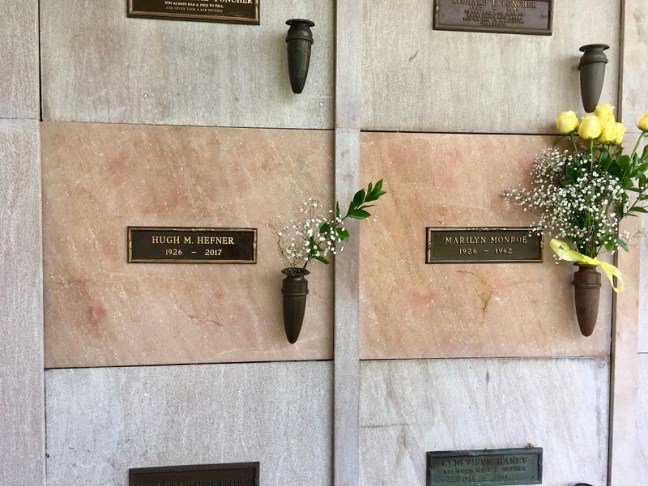
Hugh Hefner and Marilyn Monroe's mausoleum burial chambers adorned with flowers

In 2017, when I learned that Hugh Hefner would be buried next to Marilyn Monroe, and that he’d bought the mausoleum compartment back in 1992, it bothered me to distraction. It seemed so disrespectful. Encroaching. Predatory.

Gross.

I didn’t do anything with the anger (there was nothing to do but express disgust), but the ire remained, an ember not-quite smothered.

Years later, that dormant ember got oxygen from Mslexia‘s call for submissions for their “World’s Wife” section: A 500-word fictional prose monologue in the voice of the wife, mistress, sister, daughter, mother of a famous real or fictional person. We’re inviting strong voice pieces suitable for both page or performance. Please give your piece a title that explains the relationship. 

I recalled the burial arrangement. The outrage flickered, a small flame.

Around the same time, I came across the term limerence: a state of intense often involuntary romantic attachment to a person who does not reciprocate the feelings and that is often characterized by excessive preoccupation and obsessive behaviors.

The flame was now a full-on fire. I had the potential outlet, a word limit, the subjects, and title: Norma, limerence of Hugh Hefner.

I hoped to write a succinct howl, a reproach that could turn my disgust into action. A last word.

I dove into research, the disbelief and fury growing the more I learned. The facts were awful.

Beyond the fantastical element of having Monroe speak from beyond the grave, there’s nothing fictionalized in this piece of flash fiction.

How I wish the final paragraphs could go from fiction to fact, too.

Thank you to Maxine Davies and the editors at Mslexia for publishing this piece, and especially for accepting my creative interpretation of the assignment.

Read Norma, Limerence of Hugh Hefner >

Photo courtesy waltarrrrr via Flickr Creative Commons

Tie Goes to the Writer (and Editor)

A view of a prison hallway seen through steel bars

In On Writing, Stephen King says the following about getting initial feedback from close, trusted readers:

If you give out six or eight copies … you get back six or eight highly subjective opinions about what’s good and bad in it. If all your readers think you did a pretty good job, you probably did. This sort of unanimity does happen, but it’s rare, even with friends. More likely, they’ll think that some parts are good and some parts are, well, not so good. Some will feel that Character A works but Character B is far-fetched. If others feel that Character B is believable but Character A is overdrawn, it’s a wash. You can safely relax and leave things the way they are (in baseball, tie goes to the runner; for novelists, it goes to the writer). If some people love your ending and others hate it, same deal – it’s a wash, and tie goes to the writer.” (pp. 216-17)

I recently used this advice with my new flash fiction story, The Sleepwalker, published this month in Every Day Fiction. When I workshopped this story with my writing group, it got mixed feedback: Some thought it worked fine, others thought it needed an overhaul, getting more in depth with the character and the actions that created their circumstances.

Potential wash, I thought.

Then, fellow workshop member – and award-winning flash fiction writer – Kat Gonso not only championed it, but also suggested a drastic revision. She recommended leaning in to the flash and distilling even further.

In her notes, she included a ~350-word version (cut from my original draft around 500), and suggested I pare it down even further. I sat with it a bit, tweaked a few sections based on her suggestions and additional workshop feedback, and sent it out to a few journals.

Every Day Fiction expressed interest, and then also shared their team’s notes. Their reader found it problematic. The fiction editor liked it and wanted to publish it.

Tie goes to the editor, and by extension, me.

Read The Sleepwalker in Every Day Fiction >

Photo courtesy Matthew Ansley via Unsplash

The Ancients

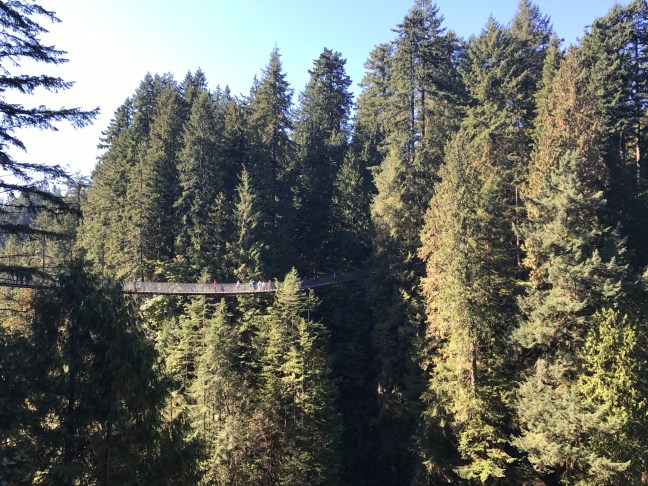
capilano_suspension_bridge_vancouver

In 2018, I traveled to Vancouver, B.C., and spent an afternoon at the Capilano Suspension Bridge. After a few hours crisscrossing between the treetops, we descended back to the ground to exit, and passed a display titled Our Biggest Guest.

It told the story of a November night in 2006, when a storm-felled Douglas Fir tree nearly took out the bridge, and the harrowing means to clear the giant: “The park had to be closed for 3 months in order for the tree trunk to be safely removed. With 17 tons of weight on the bridge, the trunk could not simply be lifted otherwise it would create a spring-like effect shooting the bridge, tree, and any one on it up into the air. Instead, small slices were removed one at a time while pulley systems carefully lifted and swung the remaining tree from its perch.”

This story was my main souvenir from the trip. From it came my newest short fiction, Arabesque, now available to read on Fiction Southeast, or check out the audio version on Audiomack.

Thanks for reading or listening!