
The Limerence

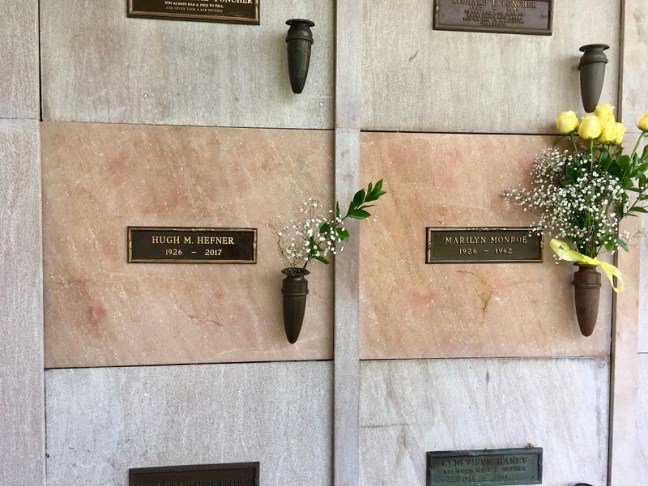
Hugh Hefner and Marilyn Monroe's mausoleum burial chambers adorned with flowers

In 2017, when I learned that Hugh Hefner would be buried next to Marilyn Monroe, and that he’d bought the mausoleum compartment back in 1992, it bothered me to distraction. It seemed so disrespectful. Encroaching. Predatory.

Gross.

I didn’t do anything with the anger (there was nothing to do but express disgust), but the ire remained, an ember not-quite smothered.

Years later, that dormant ember got oxygen from Mslexia‘s call for submissions for their “World’s Wife” section: A 500-word fictional prose monologue in the voice of the wife, mistress, sister, daughter, mother of a famous real or fictional person. We’re inviting strong voice pieces suitable for both page or performance. Please give your piece a title that explains the relationship. 

I recalled the burial arrangement. The outrage flickered, a small flame.

Around the same time, I came across the term limerence: a state of intense often involuntary romantic attachment to a person who does not reciprocate the feelings and that is often characterized by excessive preoccupation and obsessive behaviors.

The flame was now a full-on fire. I had the potential outlet, a word limit, the subjects, and title: Norma, limerence of Hugh Hefner.

I hoped to write a succinct howl, a reproach that could turn my disgust into action. A last word.

I dove into research, the disbelief and fury growing the more I learned. The facts were awful.

Beyond the fantastical element of having Monroe speak from beyond the grave, there’s nothing fictionalized in this piece of flash fiction.

How I wish the final paragraphs could go from fiction to fact, too.

Thank you to Maxine Davies and the editors at Mslexia for publishing this piece, and especially for accepting my creative interpretation of the assignment.

Read Norma, Limerence of Hugh Hefner >

Photo courtesy waltarrrrr via Flickr Creative Commons

Family History

This photo shows vials in a tray below a dropper in a lab conducting DNA tests.

Bob looked down at the nondescript printouts, no more conspicuous than a quarterly report from the dairy. Gilbert Reeder, 90% sibling or cousin.

“That’s pretty conclusive,” he said, pointing to his son’s name.

Elise worried her thumb and index finger, nail against flesh. “If intent counts for anything, I thought I was doing the right thing. I chose a nice couple and considered it done. I told the agency I could be contacted strictly for medical records, and I never intended to involve you, if she ever reached out.”

“What if it were something I could have helped with, medically speaking? From my side of the family?”

Elise shrugged. “I figured mine would be enough.”

“And you thought it wouldn’t ever come out.”

Elise ran a hand over her brow. “Honestly, no. How could I have possibly imagined the internet — and then these genetics companies accessing this information, no private agencies needed? That people all around the world would willingly spit in cups, drop them in the mail, and tag every last possible relative, with no idea of what they were actually doing? No one could have predicted that, Bob. I was thinking about our whole lives ahead – our options.”

A coal of anger glowed in his gut. “How did I have options when I didn’t even have the full story?”

“Well, you do now.”

***

Since private companies made genetic testing available to the general public, I’ve been fascinated by what the societal and cultural impacts would be, especially in local communities.

Spares and Strikes, my latest short story in Unwoven Literary & Arts Magazine, navigates one family’s experience in discovering an unknown relative’s existence, well into that person’s adulthood.

Thank you to Ameila Dellos and the team at Unwoven for publishing my work, and to the SWIG writers group and Andrew Wagner for being the best early readers.

Read Spares & Strikes in Unwoven Magazine >

Photo courtesy Louis Reed via Unsplash